Saturday, May 24, 2008

Agency workers - what we need to do now

As one Labour-supporting blogger has it, Tuesday’s announcement in relation to the rights of agency workers is “more work in progress than job done”

UNISON’s response was positively gushing, and the GMB were nearly as enthusiastic.

Before getting carried away, it is worth reflecting a little on the nature and origins of the disadvantage experienced by agency workers, and on the work which the trade unions now need to do to address this.

The underlying (and not incorrect) assumption of the trade unions’ approach to agency workers is that agency workers are generally relatively disadvantaged. Agency workers are seen as being paid a lower rate, under cutting the negotiated rate for the job and enabling the employers to play “divide and rule” to weaken the trade unions. Certainly the employers and their advisors generally see the use of agency workers in terms of cost-cutting.

The theoretical underpinning for this assumption is the theory of “labour market segmentation” or the “dual labour market theory” which I found explained online here as follows;

“Labour Market Segmentation (LMS) theory assumes that the labour market is not a homogeneous entity, but, instead, composed of two or more segments. The underlying mechanisms and structures at work with regard to payment, promotion, job security, etc. differ fundamentally among segments. In its original form, LMS distinguished two segments: a secondary and a primary sector. This is the well-known dual labour market theory. The secondary sector is characterised by low-wage jobs, no returns to human capital, and a high degree of job insecurity. The primary sector, on the other hand, is characterised by high-wage jobs, returns to human capital, large firms, and job security. Furthermore, mobility between the sectors is severely restricted, and jobs in the primary sector are rationed (due to high wages).”

In plain(er) English, the theory holds that one group of workers get job security and higher wages at the expense of another group who provide the flexibility the employers require without those benefits.

The classic application of the dual labour market theory is to large private sector organisations which employ a “core” workforce of direct employees with relative security, pensions etc. while also using a “peripheral” workforce which is insecure and far less well-rewarded. Across the economy as a whole there is evidence of agency workers providing this less well-rewarded secondary sector. Recent research (available in full online here) has found that, compared to both other temporary and permanent workers, agency workers are less satisfied in their job, have less variety and discretion over their work, are less likely to learn new things at work and are more likely to be underutilising their skills. They are also less likely to have a say in decision-making at work and are less likely to be promoted. Crucially on average, agency workers are paid £7.80 per hour compared to £11.47 for permanent workers, a difference of 32 per cent.

In recent years the growth of agency employment in London local government (which was highlighted for UNISON activists in the London Weighting strike action a few years ago) has however been driven as much by recruitment difficulties in some areas of the labour market as by the employers’ desire for a cheaper and flexible “hire and fire” section of the workforce.

The position in relation to agency workers in health and local government is therefore more complicated than the classic dual labour market theory suggests. Although certainly operating in a segmented labour market, recruited in different ways from the directly employed workforce, not receiving job security or various other conditions of service (notably pensions), agency workers are sometimes in receipt of a higher hourly rate than the directly employed workers they are working alongside. (The academic research to which I linked above finds that the highest paid agency workers are relatively less disadvantaged in terms of pay – and that is consistent with our rank and file experience of the use of agency workers in professional roles in local government).

Therefore, whilst welcoming the announcement that agency workers can look forward to “at least the basic working and employment conditions that would apply to the workers concerned if they had been recruited directly by that undertaking to occupy the same job,” many activists may feel that this could be slightly at a tangent to our concerns in the workplace.

The most important disadvantage experienced by agency workers in many of the areas in which UNISON organises is not so much direct material disadvantage of the sort which clearly arises in much of the economy as the relative insecurity highlighted by the Court of Appeal in the James case.

This insecurity, was described in the following terms by the Appeal Court; “a significant move in the direction of the casualisation of labour and the growth of a two tier workforce, one tier enjoying significant statutory protection, the other tier in a legal no man's land being neither employed nor self employed, vulnerable, but enjoying little or no protection, may create social injustice and a festering sense of grievance which would not be satisfactory in the interests of an efficient workforce, a competitive economy, a healthy society or anything else.”

The most important step we should be taking in response to the Government’s welcome announcement is to set out to recruit and organise agency workers with renewed vigour – and in organising these workers press for equality for all our members and all workers. Agency workers need trade unions. Trade unions equally need agency workers, as anyone who has stood on a picket line recently will be aware.

If the legislation now in prospect gives agency workers the statutory protections which apply to employees (particularly the right to bring a complaint of unfair dismissal) that will be the change that will be most helpful in recruiting and organising agency workers, and in securing equality within the workforce. However the critical factor will be the organising work of the trade unions ourselves.

Should we get to discuss Motion 62 at UNISON National Delegate Conference (proposed by the Greenwich branch who have a track record of sticking up for agency workers on their turf) we’ll have a chance to discuss this further.

Thinking outside the Rule Book...

I hope that any UNISON activists who have the opportunity, and have not yet taken it up, will attend one of the series of briefings on funding the challenge of Equal Pay which are being addressed by Mike Hayes, Chair of our Finance Committee. I attended a briefing in London on Thursday and participated in a constructive discussion about the ways in which UNISON can raise money to meet the cost of litigation – both against employers and defending UNISON activists.

The debate which started at that meeting carried on at a purely informal and unofficial discussion after the meeting (as I had mentioned here that it would). A few of us had a useful further discussion about amendments to Motion 116 on the agenda for National Delegate Conference (the motion from Glasgow readmitted to the agenda recently – thanks to the efforts of some influential people with a grasp of how our Union should be governed.) We also discussed Motion 45 on democracy in the Union, and its amendment.

Unfortunately, owing no doubt to a misunderstanding, the Regional Secretary had written to me requesting that I cancel the informal, unofficial meeting, on the basis that it had “no standing in Rule” and that I might be committing a disciplinary offence under UNISON Rules in convening, at my own expense, and in my own time, a meeting which, someone appeared to have informed the Union, was perceived to be a “factional meeting”.

I was pleased to be able to invite the Regional Secretary to attend the meeting in order to allay any concerns. Happily the Regional Secretary was able to attend the meeting, with a couple of friends, in time for a – purely informal and unofficial – discussion about what branches are doing in the run up to the local government strike ballot.

Official vote YES materials – including this leaflet – are now available online. The official leaflet does a good job of highlighting rising prices – the first and most important message we have to get across about the inadequacy of the employers' offer. In Thursday’s discussion we identified the need also to formulate and get across convincing arguments about our ability to win a better deal. As I have mentioned here before, I think that we should refer to historical evidence (but maybe that’s just me…)

Certainly, since we now know that the NUT will not be balloting again in time to join strike action before the summer holidays – we need to focus on how the million workers covered by the National Joint Council (and Scottish Joint Council) taking action on the most united basis possible, could shake the employers into offering a better pay deal.

I was disappointed that we weren’t offered any new insights from a colleague who has promised to come up with a “Plan B” to fight the public sector pay freeze without industrial action. Whereas at the recent Regional Committee several leading colleagues simply expressed pessimism without offering any challenges, questions or suggestions about how we might defend our members' interests, on Thursday we discussed the genuine problems we face in a thoughtful way.

As I may have mentioned previously, there is scope for unofficial as well as official activity on the part of trade union activists. Indeed some unofficial organising even gains the favour of the official structures of the Union…

I am pleased to have established that we can talk in our own time about trade union issues and the world won’t come to an end even if we are doing things which have “no standing in Rule”. Right now it is a bank holiday weekend and I may go to the beach.

Clearly my trip to the beach, having no standing in rule, will be entirely unofficial and informal and I shall not be sunbathing in my official capacity. (In fact, looking out of the window, I won’t be sunbathing at all…)

Under the circumstances I won’t invite any of you to join me, but can assure you that I will not undertake any factional activity. Although my reading matter may be suspect

Friday, May 23, 2008

Thinking seriously about a serious matter

Remembering (of course) that you read it here first, readers of this blog may be interested in two recent judgements of the Certification Officer, which need to be given serious consideration by our Union.

In the case of Tony Staunton, as I observed last week, UNISON has been told not to ban candidates in NEC elections from standing simply because they have been suspended pending disciplinary action.

In the case of Yunus Bakhsh, we have been ordered to lift a suspension imposed outside of our own Rules. In this case a suspension that ran for some fourteen months has been found to have been outside of our Rules.

Eleven years ago UNISON took a Certification Officer decision very seriously when it came to light that one or more branches may have made donations in breach of the Political Fund Rules.

That case led to more than one disciplinary investigation within the Union – although not all Certification Officer decisions do lead to such a response.

Many trade union activists are justifiably wary of making complaints about the Union to the courts or to the Certification Officer – sometimes complaints are made and withdrawn.

There is always a debate to be had about the rights and wrongs of taking an internal trade union matter outside of the union. There is also a debate to be had about whether or not the Union should put activists in the position where they feel they have no choice but to do so.

Certification Officer decisions can of course be the subject of an appeal – and it might be premature to rush to judgement about either recent case for this reason.

However it is quite clear that – as things stand – UNISON has been found to have acted in breach of our own Rules in suspending Yunus Bakhsh and to have broken the law by preventing Tony Staunton from standing for election to the NEC.

These are serious matters and I shall expect a serious discussion at the forthcoming meetings of the Development and Organisation Committee and of the National Executive Council.

I know from personal experience that internal disciplinary action within our Union, perceived to have been politically motivated, can be terminated where there is the political will to seek consensus rather than division.

Perhaps now would be a good time for decision-makers in our Union to step back and think carefully about whether the interests of UNISON members will be served by avoidable internal strife?

There is so much more we should be focusing on!

Tuesday, May 20, 2008

For Equality

I’ve blogged elsewhere about UNISON’s policies in support of abortion rights in the context of this evening’s vote in Parliament.

I hope enough pro-choice MPs care enough about women’s rights to be in Parliament voting down the anti-abortion amendments.

I don’t often comment here about my personal life or feelings, but I have to say something about today’s other vote – on amendments which may write back into law “a child’s need for a father”.

I am a father.

I try to be a reasonably good father and I hope that sometimes I succeed, and that my parenting does more good than harm to my children.

But the suggestion that the law ought to say, in whatever way, that children need a father, speaks to me of an ill-informed bigotry.

I know from personal experience that children can be raised very well by a woman on her own, and from close personal observation that children can be raised very well indeed by a loving lesbian couple.

Children need a loving and secure environment in which to grow and develop. The number and gender of the adults in that environment are both unimportant in comparison with this vital consideration.

This is my experience and the experience of my family. I get angry when I hear people express views which imply that people I love and respect are somehow not quite a “proper” family.

I am proud that UNISON stands firmly on the side of equality on this question.

I hope Labour MPs don’t let us all down in one area of policy where the Government does have a decent record.

If the bigots win this today we have to fight hard for equality and respect.

Update on Monday evening.

I am so glad we won on this.

Monday, May 19, 2008

Upsetting all the right people...

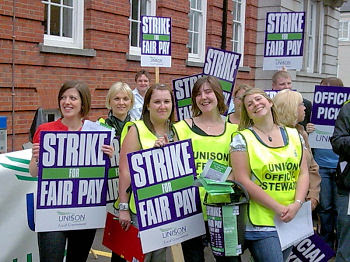
The strike season started for Lambeth UNISON last Friday with action by our members employed by OFSTED, striking against an appalling pay offer.

I was pleased to spend some time on the picket line and only slightly miffed to hear that the employer thought I had been abusive to strikebreakers!

I wasn’t of course. I am rarely even discourteous and never abusive. I did tell those crossing the picket line that what they were doing was wrong and that they should be ashamed of themselves. Perhaps that upset them, but it was and they should have been.

I don't enjoy upsetting people, but sometimes you just have to tell the truth.

Now we need to turn our attention to persuading our members in local government to back UNISON by voting for strike action over local government pay.

The strike ballot in local government, and the consultative ballot in health, together with all the issues which will be coming up at our Conference next month (including branch funding and Union democracy) are among the reasons I have convened a meeting for UNISON activists in the Greater London Region at the University of London Union at 5pm on Thursday 22 May.

With many of us present anyway for the briefing for Branch Treasurers and Secretaries on the funding of the equal pay challenge it seemed like a good opportunity to organise an entirely unofficial meeting for lay activists to take the opportunity of meeting to discuss issues of mutual concern.

I hope that by calling such a meeting I won't have upset anyone...

Friday, May 16, 2008

A positive development for the rights of union members

A little more than a year ago I expressed my concern here at a decision to prevent a UNISON member standing for election to the National Executive Council because they had been suspended from holding office (although at that time they had not been found guilty of any disciplinary offence).

This is what I said in March of last year;

Suspension is not a disciplinary sanction but a precautionary measure. If UNISON were to interpret our Rules so as to prevent members who are suspended from holding office from standing for election this would deny members the democratic right to nominate and vote for a candidate who has not been found guilty of any offence. It would leave those who decide about such matters vulnerable to the perception that decisions on suspensions were being taken in order to pre-empt Union elections.”

The case has now been decided by the Certification Officer, as UNISON did indeed stand by this questionable interpretation of the Rules and this was challenged. The Certification Officer has found that UNISON breached the law by preventing a member from seeking election to office because they were suspended.

The Certification Officer says, in a judgement which will be published soon;

“First, the right of a union member to stand for election is an important right of membership, as in any democratic organisation, and should not be taken away unless the members have so decided in a clearly expressed rule to that effect. Secondly, at the time that a rule C7.4 suspension is imposed, the member has not been found to have committed a disciplinary offence and it is therefore to be supposed that the suspension is not intended as a penalty.”

I won’t comment further on any other aspects of the case in question at this time, but will observe that – while the Union clearly can appeal this judgement and has previously been successful in appeals against rulings of the Certification Officer – this particular point is straightforward and ought to be accepted. A precautionary suspension ought not to put the person suspended at an avoidable disadvantage, otherwise it amounts to the premature imposition of a disciplinary sanction.

We wouldn’t accept it from the employers and we ought not to have applied it to ourselves. All UNISON members owe a debt to the claimant who pursued this case.

Off to the picket line

I am on my way to the picket line to support striking members of the Lambeth UNISON branch employed by Ofsted.

UNISON members in Ofsted undertake highly demanding jobs – responsible for inspecting childcare, early education and children’s social care, and ensuring that standards are adhered to and millions of young children are cared for safely and properly.

Ofsted has imposed a pay award which leaves most of our members facing a pay freeze or below inflation uplift for three years.

Rising cost of living

· A third of UNISON members are having their salaries frozen for two years – for a quarter the pay freeze is due to last three years! At a time when the cost of living – gas, food, fuel, petrol – has been going through the roof.

· Even where our members have been given a rise, for half of them it amounts to 2% or less at a time when the real cost of living is rising at 4%.

Winners and losers approach bad for morale

All public sector employers have recently been subject to Government restrictions in what they can pay. But in Ofsted a bad situation has been made worse by the decision to give some staff – in more senior grades – increases significantly above inflation. With a limited pot of money to spend that has led to real hardship for the rest. This has been divisive and bad for morale.

The most recent survey of Ofsted staff showed that stress and workplace bullying had risen. It is time management at Ofsted recognised the demanding work ALL their staff perform.

Campaigning for a fair pay increase for all staff

The unions are calling on Ofsted to release funds it has set aside elsewhere and to secure additional monies from the Treasury so that all its hardworking staff can have a fair pay rise. Seems fair enough to me!

Thursday, May 15, 2008

Leadership at the Regional Committee...

Today’s meeting of the UNISON Greater London Regional Committee ploughed through a fair bit of business. I will pick out a few important items here.

Industrial action ballots

One point about which I asked was the problem – long identified by the Regional Local Government Executive – of delays in approving requests from branches for industrial action ballots. A meeting between the Regional Secretary and the Chair and Secretary of the Regional Local Government Committee, which was due to take place after the last meeting in March, is still outstanding. The Regional Secretary was able to able to assure the Committee in response to my question that the issue of “perceived delays” would be discussed. I look forward to hearing more…

A number of branches have experience of excessive delays in the processing of requests for industrial action ballots, sometimes leading to the Union achieving a less satisfactory result of our members than if the requests had been dealt with more promptly.

Regional pool applications

I also asked about payments to branches from the Regional Pool to assist in recruitment and organising initiatives. Both of the co-Chairs of the Recruitment and Organisation Committee were swift to respond with assurances that branches should make applications – details are online here (soon to be updated). Branches should consider applying to the Regional Pool in order to provide a shot in the arm to their recruitment activities.

Public sector pay

The debate about public sector pay produced some interesting contributions from supporters of the Regional Council Officers elected in February. While a number of experienced Regional Committee members made balanced contributions reflecting on the challenge which is posed for the Union by the members’ rejection of the local government pay offer – others seemed hostile to strike action almost on principle.

The Deputy Regional Convenor said that health workers would not vote to strike, a view echoed (in relation to low paid members in his own branch) by a fellow Regional Committee member from the health service who was particularly agitated about calls for strike action being made by higher paid health workers, such as nurses. The Regional Finance Convenor reported that his shop were unanimously opposed to strike action, and the Regional Publicity Officer that she would take her mandate from the members of her branch who had voted by a majority to accept the employers’ offer.

Unfortunately none of those making contributions to the debate along these lines offered any suggestions for other strategies which could be adopted in order to prevent the Government and employers forcing through below-inflation pay rises which reduce our members’ living standards. In a lay led trade union those elected to leadership positions need to take their responsibilities a little more seriously.

It was left to Malcolm Campbell of the Croydon branch, in the final contribution of the debate on pay to make the obvious point that those who can least afford to take strike action are often also those who are least able to afford not to take such action. In the absence of any alternative strategy, those repeating the tedious mantra of opposition to strike action advocate by default doing nothing and watching the living standards of our members fall.

The London and local elections

The debate about the outcome of the London elections, kicked off by an overview from the Regional Secretary was also marked by widely divergent opinions.

In relation to the overall results, I expressed the view that the trade unions need to prepare for the unwelcome eventuality of a Conservative Government because – as Sonya Howard from true-blue Kensington and Chelsea pointed out – we have to work with whoever is elected in order to represent our members.

I argued that we should push harder for union policies in our arguments with the Labour Party and Labour Government both because those policies would be more popular – and more likely to lead to the re-election of a Labour Government – and because, if there is a change of Government, we might as well try to get as much as we can beforehand.

The Regional Finance Convenor, a zealous convert to the cause of Labour, felt that I was quite wrong and that the Tories were most unlikely to win the next General Election. He argued that we should avoid calling strikes, lobbies and rallies in order to help to assure this outcome.

As a Labour Party member of some twenty eight years standing I very much want to see a fourth term for the Labour Government rather than the only alternative Government on offer – which would be led by David Cameron. However the first job of a trade union is to stick up for our members. We can do this with industrial or with political action.

The prescription being offered by a number of colleagues today appeared to amount to opposition to industrial action with political action limited to support for the re-election of a Labour Government. I look forward with interest to the coherent articulation of this fascinating project by the Regional lay leadership.

While we are waiting for this I suggest that our priorities must be to campaign for industrial action over pay, and to organise maximum attendance at the TUC lobby of Parliament on 9 June. Those who know only what won’t work and can offer no positive suggestions will best serve the members by quiet contemplation.

Greater (London) expectations of the Regional Committee

Today is that most exciting of days – there is a meeting of the Greater London Regional Committee of UNISON. I have read elsewhere in the blogosphere that great things are now to be expected of this Committee and I therefore hurry towards the meeting full of eager anticipation.

We’ll be discussing recruitment and organisation, of course. I am keen to find out whey the Regional Pool is being so little used these days. A few years ago when myself and Louise Couling were co-Chairs of the Recruitment and Organisation Committee we worked with the then Secretary of the Committee to push substantial sums of money into the hands of branches with good ideas to develop UNISON organisation. It is a shame that this seems to have come to a halt.

We’ll also be discussing pay, of course, the health service, equal pay and – no doubt – the outcome of the London elections. I’ll report here later on about anything of particular interest.

We will also be looking at arrangements for the Regional Council meeting on 5 June, to which branches have submitted very few motions, but which will in all probability be taking place during a national local government strike ballot, at the close of consultation on health service pay and a few days ahead of the TUC lobby of Parliament.

I hope that the Regional Committee will be able to work out how to use the Regional Council meeting to good effect in these circumstances – and that the Regional office and leadership will use their proven skills in encouraging attendance to make sure that our Region pulls its weight in the campaign on public sector pay.

Islington U turn welcomed

Islington UNISON and others have been fighting privatisation of our in house Homecare (Dementia care service) some 95 staff, for just over two years. Yesterday I meet with a councillor to further lobby him about the issue but was instead informed that they had decided not to continue with privatisation but instead keep the service in house, in fact there maybe more in house jobs then when we started the process.

A year ago this privatisation looked inevitable indeed management had informed us there would be no prospect of changing this. I think a number of factors have lead to this U Turn. Two years ago we made homecare privatisation an issue in the council election by handing out postcards to defend home care and keep it in house. After the election the council was technically hung and we had 24 out of 48 councillors pledged to keep the service in house, but the lib dems took control of the council with the casting vote of the mayor and the homecare privatisation policy continued.

The privatisation was delayed as two proposals had to be scrapped. Then the Care UK scandal finally produced and internal reporting the middle of last year which was very critical of the Director of now Housing and Social service. Islington UNISON called for her to resign, shortly after that her retirement was announced but unfortunately not until May this year. Earlier this year they created the an in house enabling service which meant that half the home care jobs will be kept in house. As a result of a dispute about the selection process in April we asked them to look again at keeping the service in house. The new director took up the post last week, and the final nail in the coffin the election results for the GLA would suggest the ruling group would have been wiped out of the council had they themselves been up for election.

Whilst the proposal needs to be finalised we now have an in-house enabling service of 43 staff and a likely renamed complex needs service of around 60 staff in house. This is a huge victory for the Islington branch perhaps one we will be shouting about.

Wednesday, May 14, 2008

Too easy to please?

In some circumstances it is good to find someone who is easy to please.

Whether trade union members should find this characteristic attractive in their own leaders is another matter…

UNISON welcomes the Government’s legislative programme.

Does it include the repeal of the anti-union laws? No

Does it include a programme of Council house building? No

Does it promise an end to the public sector pay freeze? No

Does it reverse the policies of privatisation? No

Should UNISON’s leadership welcome this programme?

Update on Thursday morning – having looked back over the decisions taken by UNISON’s National Executive Council in relation to NEC policy on motions before the forthcoming National Delegate Conference I am even more perplexed at our publicising such an unqualified welcome for a legislative programme which meets so few of our aspirations and ignores so many of our priorities.

I wonder if my NEC colleagues on the Policy Committee would approve of this unstinting praise for the Government, or whether they would agree with today’s Morning Star that “the role of trade unions at present must be to make the government listen to the labour movement rather than to act as cheerleaders for an administration that cannot conceal its contempt for them and their members”?